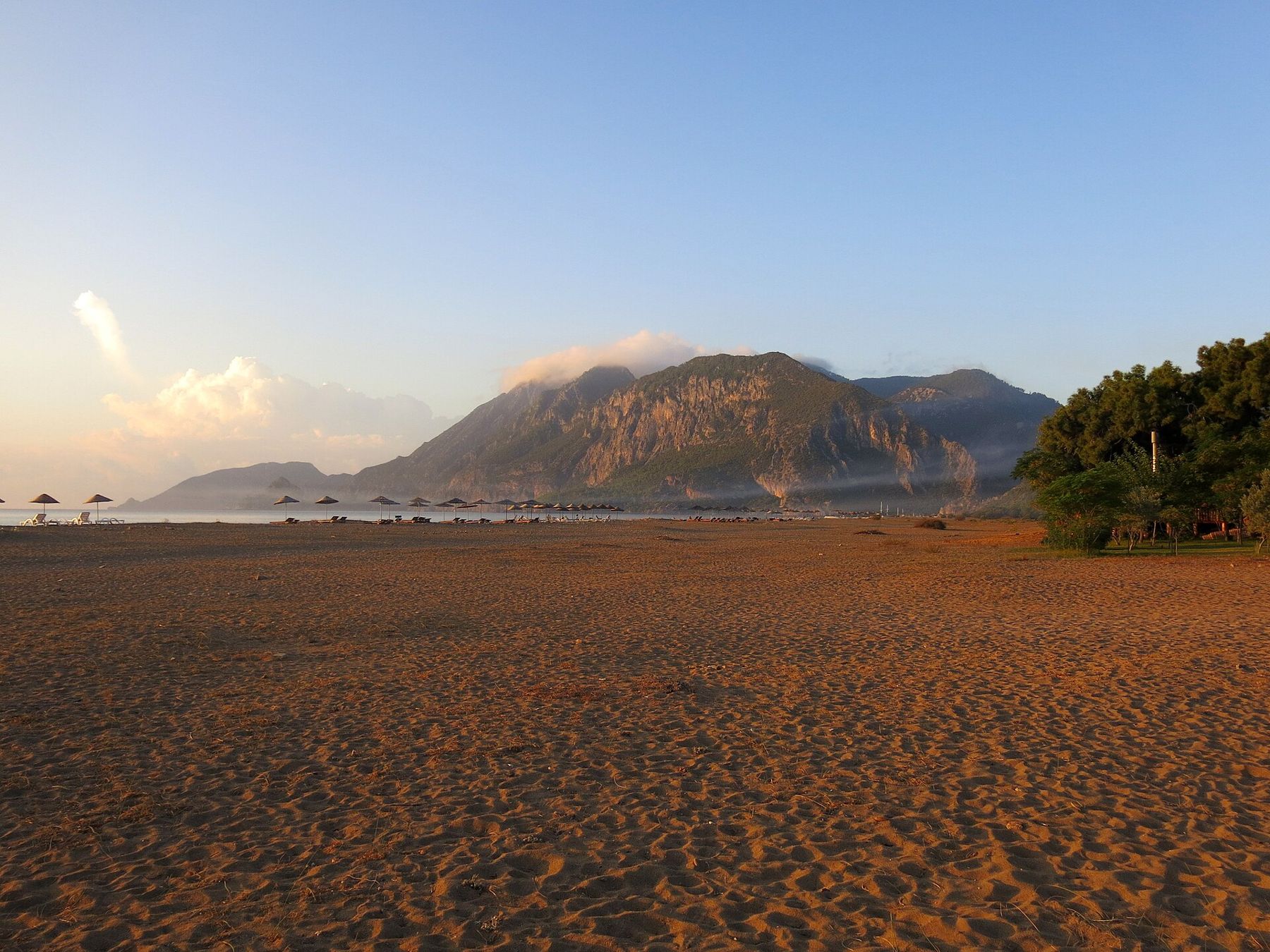
Çıralı is a beach that asks something of you. It is a long, open bay of sand and small pebbles, around three kilometres from end to end, with forested mountains rising steeply behind it and clear water in front. It is also one of the places on this coast where loggerhead turtles come ashore to nest, and the way you use the beach, especially after dark, matters.
The village behind the shore has grown slowly. Instead of a seafront of large buildings, you find small guesthouses and gardens set back among orange and lemon groves, with dirt lanes leading down to the sand. The result is one of the quietest beaches of its size on the Antalya coast.
The bay and the mountains
From the middle of the beach you see the whole curve of the bay. To the south it ends at the cliffs around the mouth of the Olympos valley; to the north it runs toward a rocky headland. Inland, the ridges of the Beydağları climb steeply, and Tahtalı Dağı, the highest peak on this part of the coast, often wears a cap of cloud in the morning.
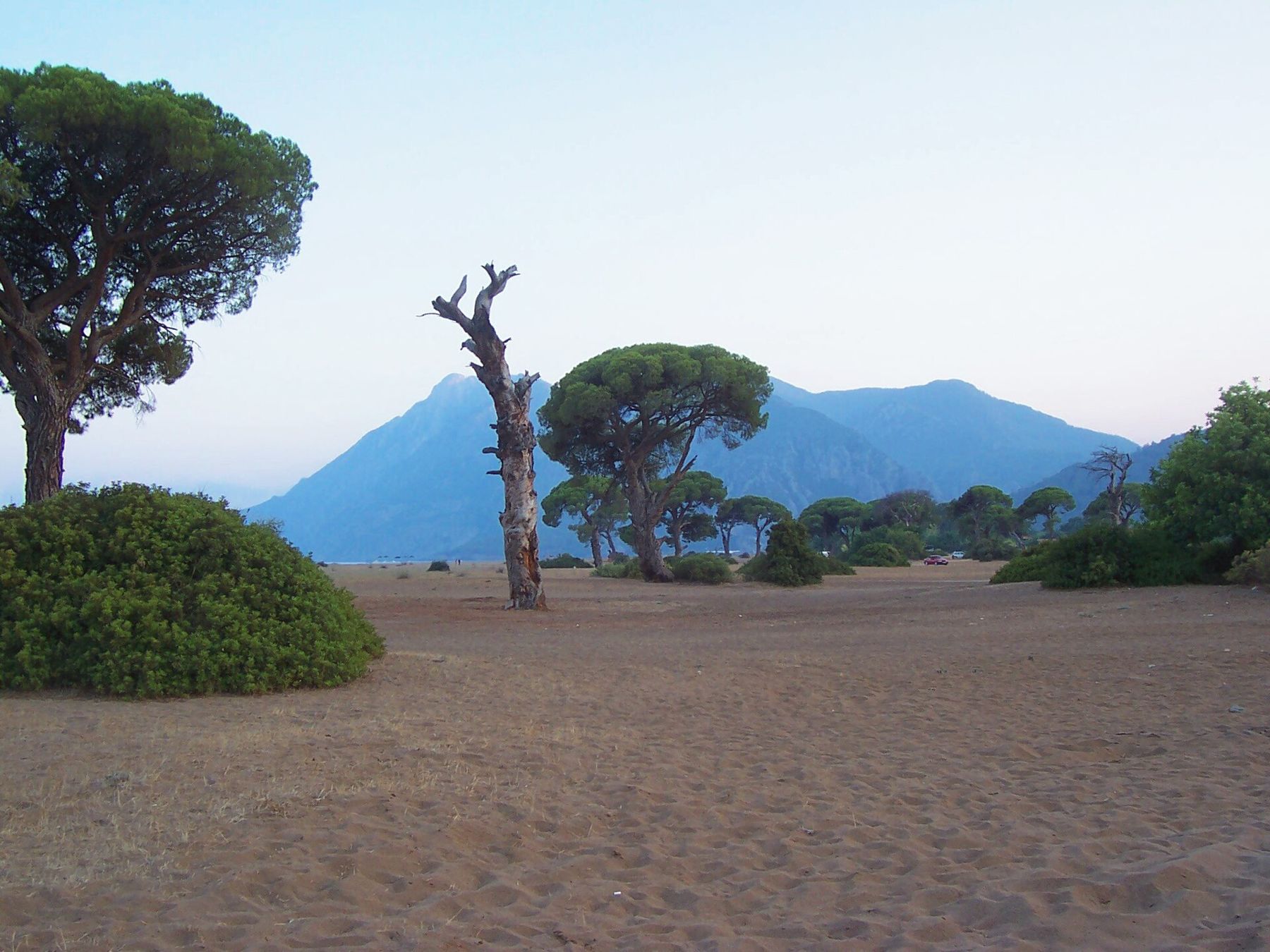
The beach itself is wide and open. Near the waterline it is mostly small pebbles and coarse sand; further back it softens into finer sand, scattered with low scrub and stone pines. There is little shade on the open shore, and the light on a clear morning, golden on the sand and blue on the mountains, is one of the good reasons to be up early here.
Loggerhead turtles and the night rules
Loggerhead sea turtles nest on Çıralı beach in the summer months. Females come ashore at night, dig a hole in the sand above the waterline and lay their eggs, then return to the sea. Some weeks later the hatchlings dig their way out, usually at night, and head for the brightest horizon, which on an undisturbed beach is the sea.
Everything about the beach rules follows from that. Lights confuse hatchlings and can draw them inland, away from the water. Umbrellas and loungers pushed into the sand can damage nests and block the way to the sea. Noise and people on the beach at night disturb nesting females. So, in general terms:
- Keep off the beach at night during the nesting season unless local rules allow it.
- Do not shine torches or phone lights toward the sand; use a dim red light if you must walk near it.
- Do not push umbrellas into the sand near marked or protected nests.
- Keep well back from any turtle or hatchling you see; never touch or lift one.
- Leave the beach as you found it, with no holes, sandcastles or rubbish.
Nest areas are often marked with small cages or signs during the season. Rules and hours change, so read the notices at the beach entrances and ask locally when you arrive. A similar set of rules applies on the long sand at Patara, further west along the coast.
The village behind the sand
Çıralı is reached by a minor road that leaves the main coast highway and winds down through the forest to the plain. At the bottom, a single main lane runs parallel to the shore, with side tracks leading to the beach. Most buildings are low, set in gardens and orchards, and the evening sounds are crickets, frogs and the sea.
That quiet is deliberate. Building on the shore is restricted, partly to protect the turtle nesting grounds, and the village has grown around small guesthouses and family-run places rather than large resorts. You will find simple places to eat and stay, but no promenade, no seafront high street and little nightlife. Evenings here are for walking the lanes, looking at the stars and going to bed early.
On the mountainside above the northern end of the village, natural gas seeps from the rock and burns as small, permanent flames, a landmark known as the Chimaera, reached by a path through the forest and often visited at dusk.
Swimming at Çıralı
The beach shelves at a moderate angle: deeper than the sand east of Antalya, gentler than the steep pebbles of Konyaaltı. A few steps take you over small pebbles into clear water, and a short swim out brings you over a sandy bottom in deep blue.
At the southern end, a stream reaches the sea from the Olympos valley. Here the water can be noticeably colder, with a layer of fresh water lying on top of the warmer sea, and after heavy rain the mouth can carry a current. It is a refreshing place to cool off on a hot day, but swim with care near the outflow.
There is no continuous lifeguard cover on much of the beach. On windy afternoons, waves can build and break across the whole bay. Choose calm mornings for longer swims, stay within your depth if you are unsure, and take the flags or local advice seriously when they are out. For a broader picture of afternoon breezes on this coast, see the guide to wind, waves and flags.
The sea at Çıralı is typically roughly 17–19°C in April, around 24–26°C in June and roughly 27–29°C in August. September and early October keep much of that warmth, at around 25–27°C and then 22–24°C.
Getting there and when to go
Çıralı lies southwest of Kemer, off the main coast road. Minibuses on the coast road can drop you at the turn-off, and local transport down to the village runs in season; check current arrangements before you travel. With a car, the descent is narrow and winding, so take it slowly.
Late spring and early autumn are the best times to come. The water is warm enough, the village is calm, and the heat of midsummer has not yet arrived or has already passed. Nesting season runs through the warm months, so the night rules apply for much of the swimming year.
What to bring
Bring your own shade, because the beach is open and the trees sit back from the water. Water shoes help on the pebbles near the waterline. A small torch with a red filter is useful for the lanes at night and kinder to the turtles. Carry drinking water and take every piece of rubbish home with you. Çıralı stays the way it is because the people who use it treat it lightly.