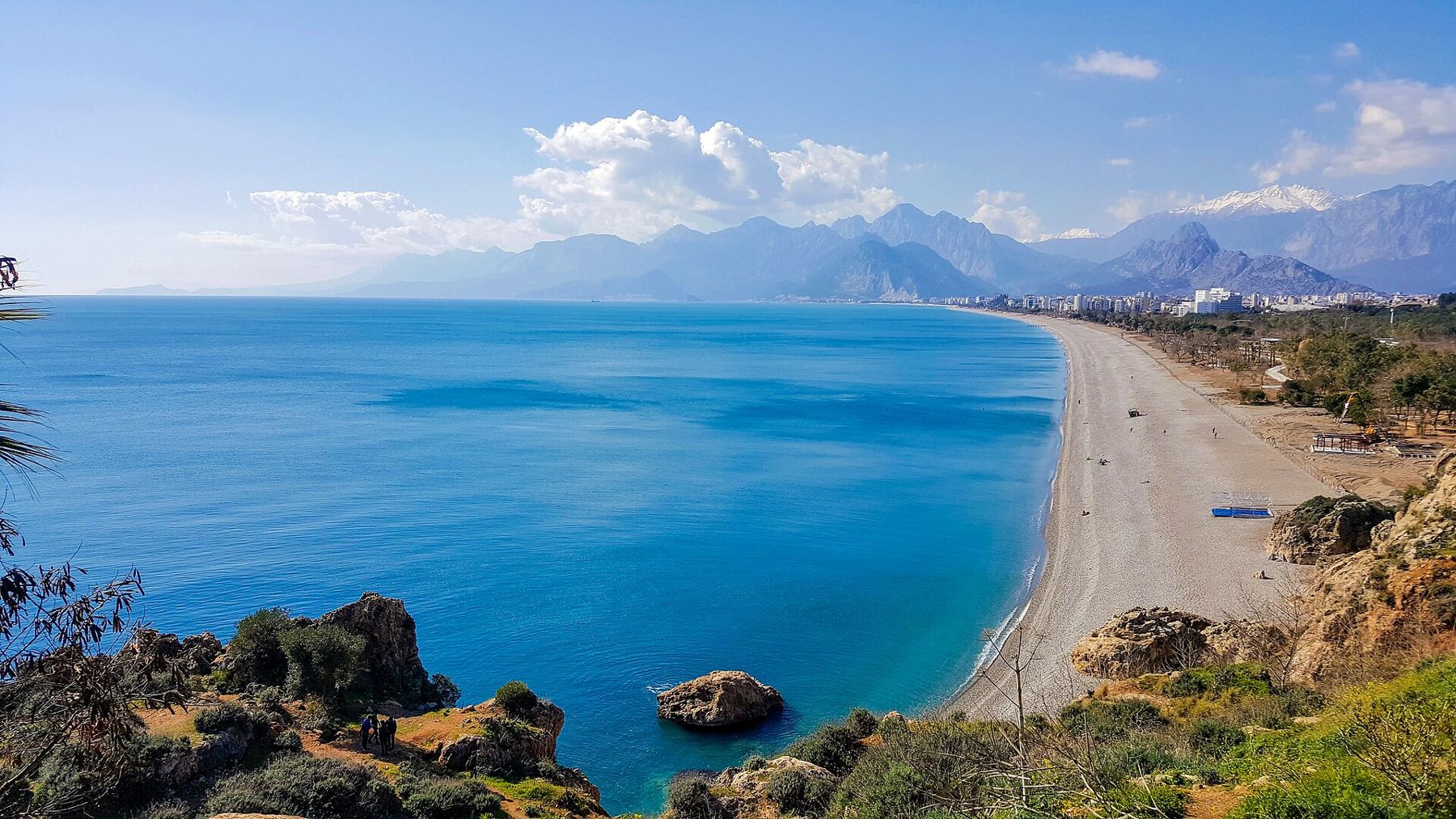
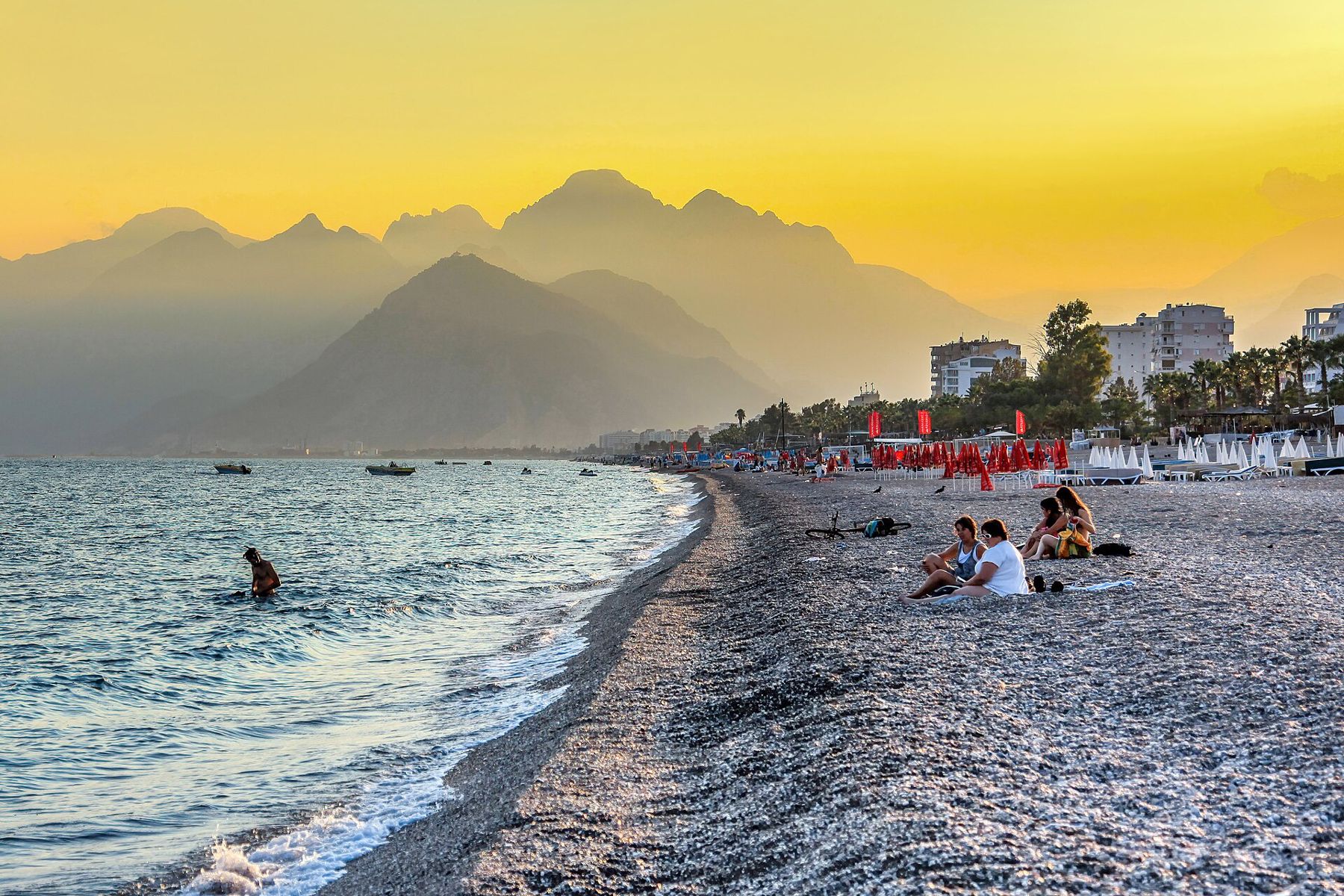
Konyaaltı is the beach that Antalya looks at every day. It starts below the cliffs on the western edge of the city centre and runs west in one long, gentle curve, roughly seven kilometres of grey and white pebbles between the city and the port. Behind it lies a strip of parkland and apartment blocks; in front of it the water turns from pale green to deep blue almost at once. Across the bay, the Beydağları rise straight out of the sea, a ridge of limestone peaks that often keeps snow on its tops well into spring.
It is a city beach in the plainest sense. People swim here before work, walk the promenade after dark and come down with a towel and a bottle of water on a free afternoon. You do not need a plan to use it. You need decent shoes for the stones, something to lie on, and a feel for how fast the bottom drops away.
The shape of the shore
From the cliffs at the eastern end you see the whole thing at once: the beach bending away toward the mountains, the line of foam where the small waves land, and the sea opening out to the south. The eastern stretch, nearest the centre, is the busiest. Here the seafront park sits right behind the pebbles, with lawns, paths, a cycle track and plenty of benches under the trees.
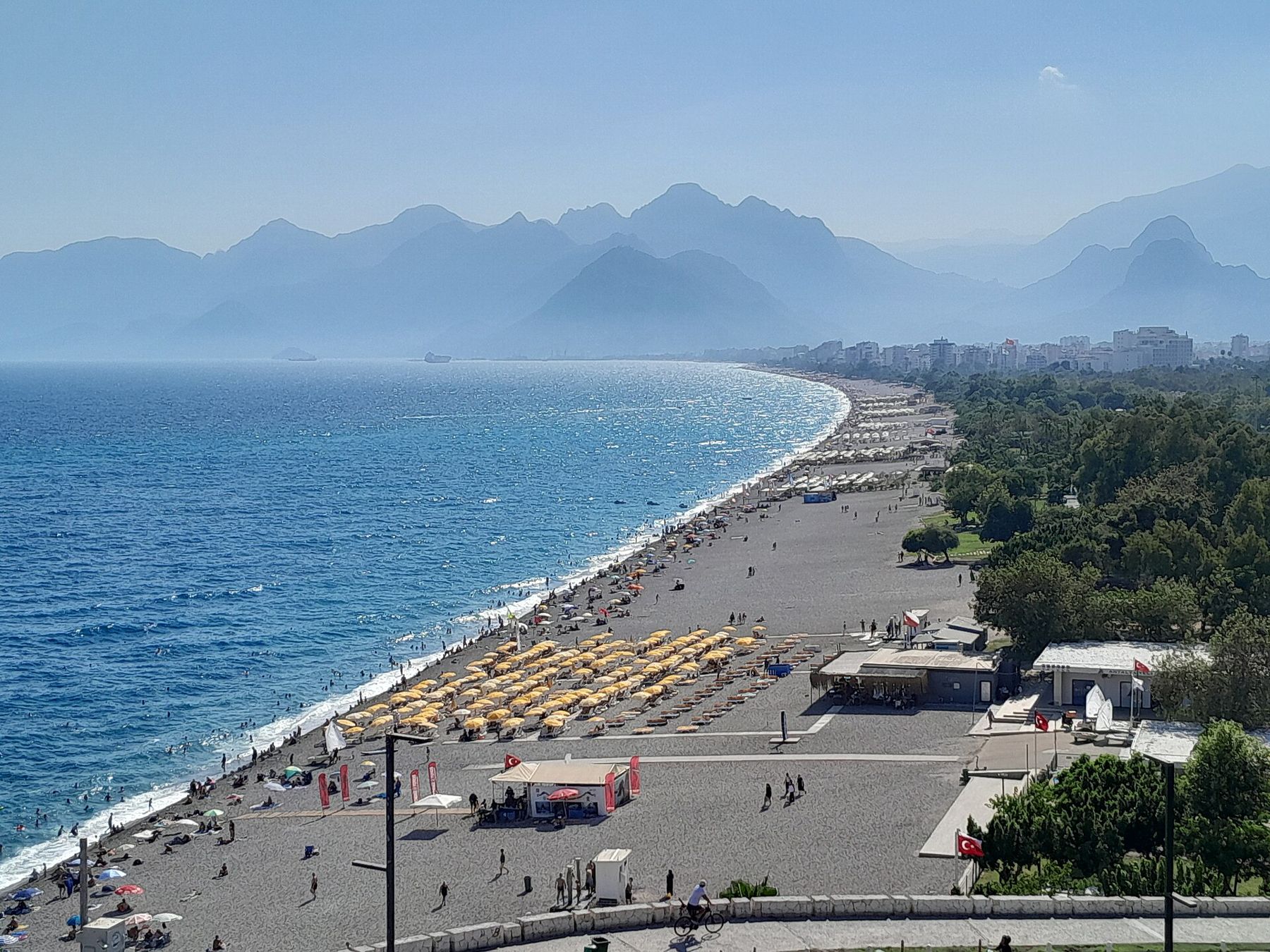
Further west the beach widens and the city thins a little. There are long sections where you can lay a towel on the bare stones with nobody near you, especially on weekday mornings. Toward the western end the shore runs on toward the port, and the views of the mountains get closer and steeper.
The pebbles are mostly small and rounded, a mix of grey, white and darker stones that clatter as each wave pulls back. They stay cleaner than sand and keep the water clear, but they get hot by midday in summer. A thin mat or a folding beach cushion makes a big difference, and so does a pair of water shoes.
The steep shelf and the deep water
The thing that surprises most first-time swimmers at Konyaaltı is how quickly the bottom falls away. You take two or three steps over the stones and the sea is at your waist; a few more and your feet no longer touch. This is what gives the beach its colour. Deep water a short swim from the shore reads as dark blue even on a hazy day, and the visibility is often good enough to watch your own shadow on the pebbles below.
You take two or three steps over the stones and the sea is at your waist; a few more and your feet no longer touch.
That depth is a pleasure for strong swimmers and a reason for care with children. Small children are better off playing at the very edge, where the waves wash over the stones, than wading out. On calm mornings the sea is flat and glassy and easy to read. On windy afternoons, waves build up and break hard on the steep shelf, and getting in and out over moving pebbles becomes a real effort. If the swell is running, choose your moment between sets, keep your shoes on, and do not linger in the break.
Lifeguards, flags and marked swimming areas cover parts of the beach in the main season; their extent changes from year to year, so check what is in place when you arrive. For more on reading flags and afternoon wind on this coast, see the guide to wind, waves and flags.
The promenade and the park behind it
A long promenade and seafront park follow the beach for much of its length. It is one of the best places in Antalya simply to walk: wide paths, a separate cycle track, shade from pines and palms, and the sea always in view. Early morning brings runners and swimmers; late afternoon brings families, and after sunset the paths fill with people out for the cooler air.
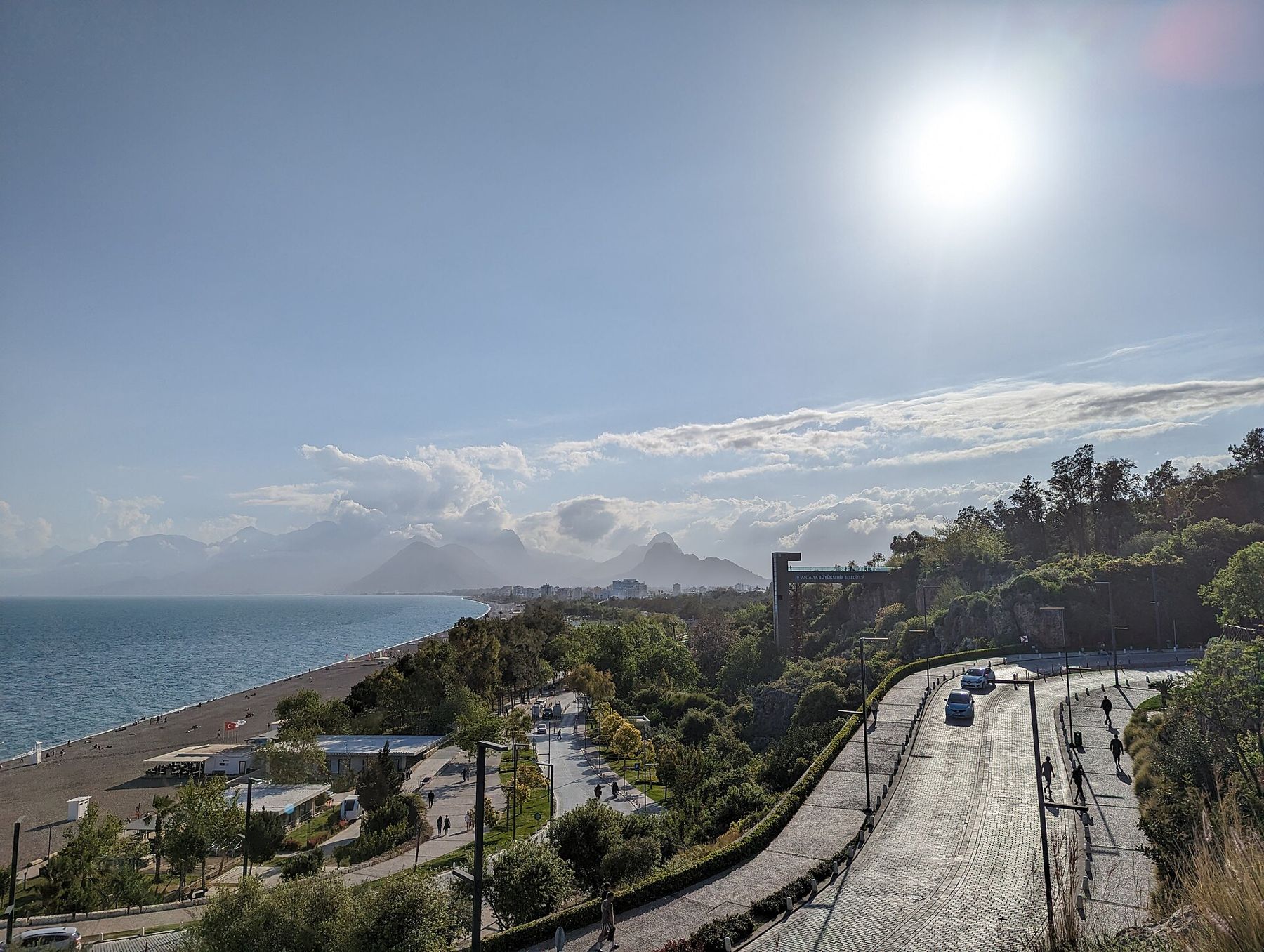
At the eastern end, the beach sits at the foot of the cliffs that carry the city above. A winding road and a public lift link the cliff top to the shore, and the views from the top, back along the whole curve of the beach, are among the finest in the city. The Antalya Museum stands near the top of the cliffs at this end, a useful landmark if you are finding your way down.
Along the beach you will find public showers, changing cabins and toilets at intervals, as well as stretches where loungers and umbrellas are set out for rent. Large parts of the beach remain open shore where you can simply spread a towel. What is on offer, and what it costs, shifts from season to season, so check on the spot.
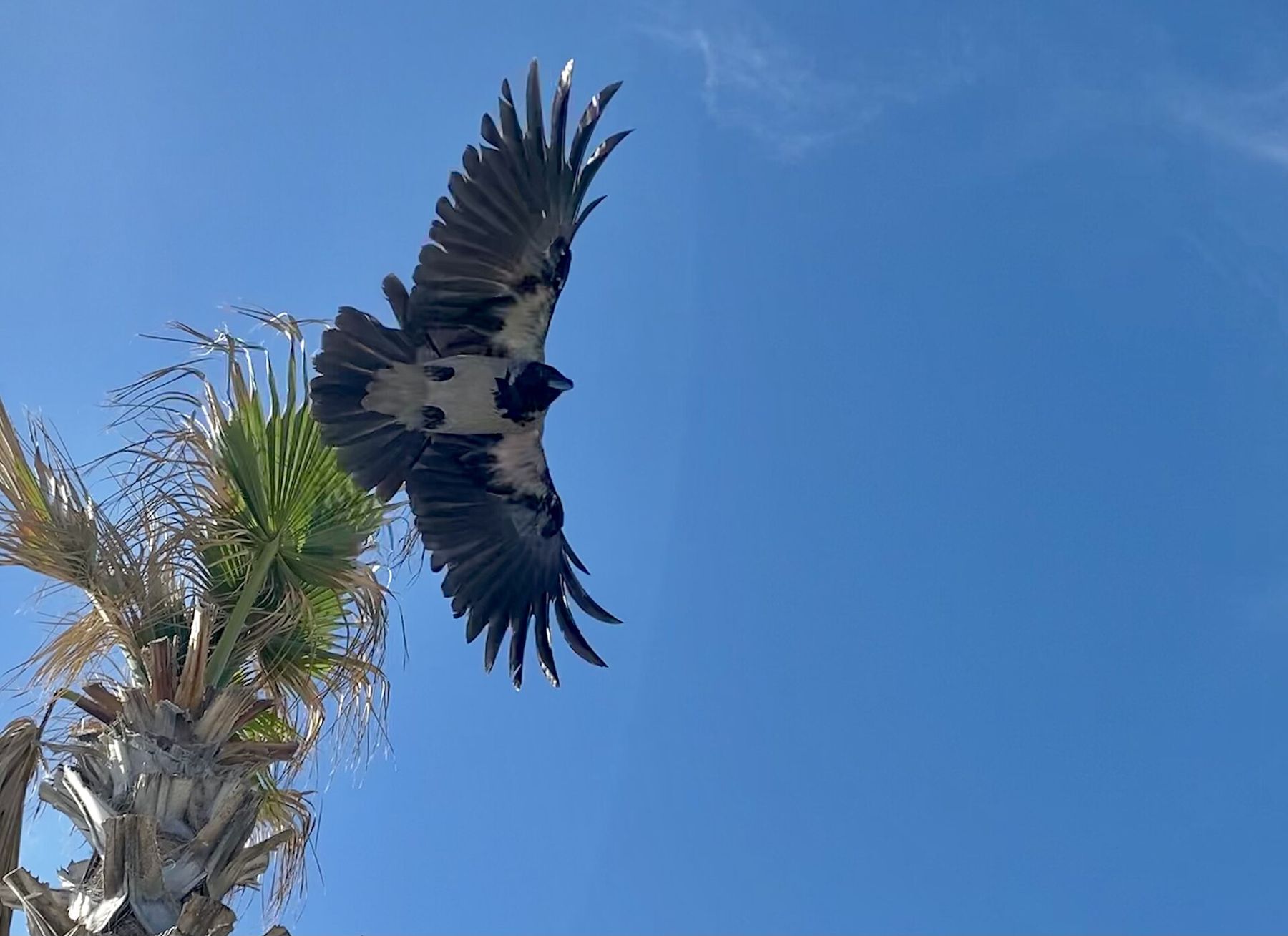
Hooded crows patrol the beach and the park in numbers. They are bold, clever and quick to investigate an unattended bag, so keep snacks zipped away when you go in for a swim.
Water, light and the mountains
Konyaaltı is a west-facing view, and the evening is when it looks its best. As the sun drops toward the Beydağları, the peaks turn into layers of grey and blue silhouettes, and the sea picks up a sheet of gold. Swimming at this hour, with the mountains in front of you and the water still warm from the day, is one of the simple pleasures of living in or visiting Antalya.
In the morning the light is clearer and the water calmer. The mountains look close enough to touch, every ridge sharp, and the sea is often still enough for long, easy swims parallel to the shore. In spring, snow on the peaks makes a strange and lovely backdrop to a swim, though the water at that time of year is cold enough to keep most swims short.
The sea here follows the general pattern of the Antalya coast. It is typically roughly 17–19°C in March and April, warming to around 24–26°C by June and roughly 27–29°C in August. September is often the most comfortable month, with water still around 25–27°C and the crowds thinning. By October it is typically roughly 22–24°C, still very swimmable on a sunny day. The month-by-month picture across the whole coast is set out in the guide to sea temperature through the year.
Getting there and getting around
Konyaaltı is easy to reach without a car. City buses run along the roads behind the beach from central Antalya, and tram and light rail lines serve parts of the city near the eastern end. Routes and stops change, so check the current options at your accommodation or at a city transport point before you set out. Taxis are plentiful, and the promenade itself is pleasant to walk or cycle.
From the old town, Konyaaltı is a short ride west. If you are staying near the harbour, you can also swim closer to home: the small beaches below the walls are covered in the guide to swimming below the old town walls. For a softer, sandier shore on the other side of the city, the beaches east of the centre are a different experience altogether.
Practical sense for a day on the pebbles
- Water shoes help both on the hot stones and when getting in and out through the waves.
- A mat or folding cushion is far more comfortable than a towel alone on pebbles.
- Shade is limited on the open shore; bring a hat, or plan around the trees of the park behind.
- Mornings are calmest; afternoons are often windier and wavier.
- Keep valuables to a minimum and an eye on your bag, both for people and for crows.
- Check flags and lifeguard cover each day; conditions change quickly on a steep shore.
Konyaaltı rewards repeat visits. You learn which stretch is quietest, which hour has the flattest water and where the shade falls in the park. And whatever the hour, the view across the bay to the mountains stays the same reason to come back.